

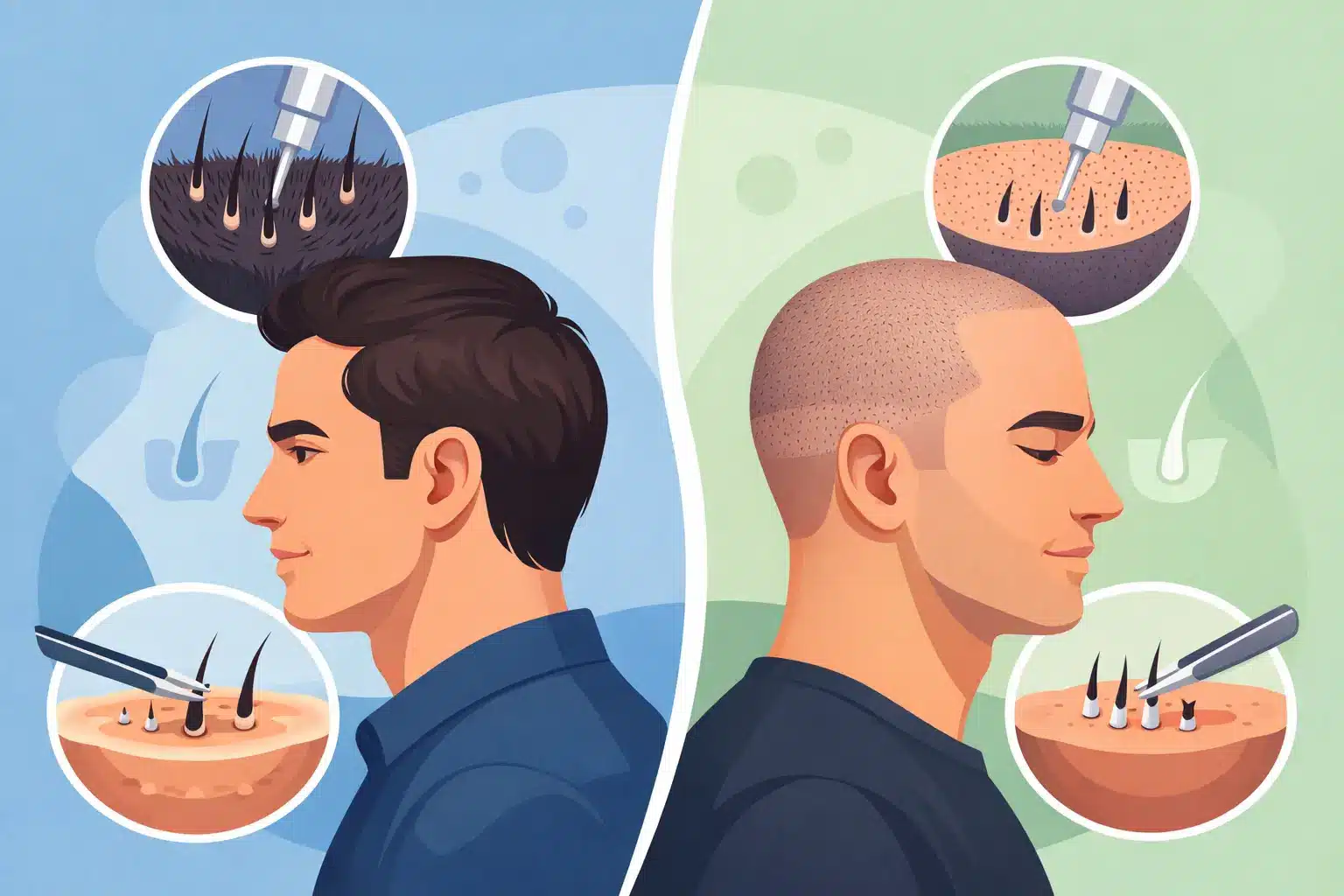
A hair transplant should fit your life as well as your hair-loss pattern. When considering non-shave FUE versus shaved FUE, the central question is usually not which procedure is better overall, but which approach allows the safest, most precise treatment for your goals, hair characteristics and need for privacy.
Both methods use Follicular Unit Extraction, or FUE. Individual follicular units are carefully removed from the donor area, usually at the back and sides of the scalp, then placed into thinning or balding areas according to a personalised design. The key difference is the extent to which the donor hair, and sometimes the recipient area, is trimmed before surgery.
For many patients in professional or public-facing roles, the ability to keep their existing hairstyle can be a deciding factor. For others, shaving offers practical advantages when a larger procedure is required. A proper medical assessment is the right place to make that decision.
What is shaved FUE?
In a shaved FUE procedure, the donor area is clipped short. Depending on the treatment plan, the recipient area may also be trimmed to give the surgical team clear access for graft placement. With the hair reduced, the follicles are easier to see, extract and sort with precision.
This is the conventional FUE approach and is often well suited to patients requiring a larger number of grafts. It can make the procedure more efficient because the surgeon has unobstructed visibility of the donor zone and can assess spacing between extracted follicles carefully.
For someone who already wears their hair short, or who is comfortable with a short haircut during the recovery period, shaving may feel like a straightforward and practical choice. The appearance of the donor area is more obvious initially, but the hair grows back over the following weeks.
When shaved FUE may be recommended
Shaved FUE is commonly considered where there is more extensive hair loss, a larger crown area to restore, or a need for a high graft count in one session. It can also be the preferred option when the donor hair is particularly dense, curly or difficult to separate without clipping.
It does not mean a better result by default. Natural-looking outcomes depend on diagnosis, donor management, hairline design, graft handling and placement angle. However, the visibility created by shaving can give the clinical team greater efficiency and control in appropriate cases.
What is non-shave FUE?
Non-shave FUE, sometimes called unshaven FUE, is designed to preserve the appearance of a patient’s existing hairstyle as much as possible. Rather than clipping the full donor area, the clinical team trims selected small sections of donor hair. These areas are usually positioned beneath surrounding longer hair, which can help conceal the extraction sites once the hair is styled normally.
The recipient area may also be treated without shaving in suitable cases. This is particularly attractive to patients who want to return to work, social commitments or family life without a visibly shaved scalp.
Non-shave FUE requires careful planning and a high degree of technical precision. Long existing hair must be separated safely during extraction and protected during implantation. It is therefore not simply shaved FUE with less clipping. It is a specialised approach that may take longer and may not be appropriate for every treatment plan.
The discretion advantage
The most obvious benefit of non-shave FUE is discretion. If you have enough surrounding hair to cover the trimmed donor sections, you may be able to maintain a familiar hairstyle while healing. Early signs such as redness, small scabs or temporary shedding still need to be managed carefully, but the procedure can be considerably less noticeable than a fully shaved approach.
This can be particularly valuable for women with diffuse thinning, men with longer hairstyles, and professionals who do not want a dramatic change in appearance. Discretion is not vanity. For many people, it is a practical concern that affects confidence and timing.
Non-shave FUE versus shaved FUE: the meaningful differences
The choice involves more than whether you want to cut your hair. Each approach has implications for procedure duration, graft numbers, concealment and surgical planning.
Procedure time and efficiency
Shaved FUE is generally more time-efficient. A closely trimmed donor area allows follicles to be identified and removed without repeatedly moving longer hairs aside. This can be useful for extensive sessions where a substantial number of grafts are needed.
Non-shave FUE can take longer because each stage requires more delicate management of the existing hair. Longer operating time does not make it inferior, but it does mean the clinician must consider whether it remains the best option for the number of grafts required and the patient’s comfort on the day.
Graft count and coverage goals
Patients with a small frontal hairline concern, temple recession or a defined localised area may be excellent candidates for non-shave FUE. The required graft numbers can be compatible with selective trimming and discreet coverage.
Where hair loss is advanced, the crown needs significant density, or the goal is to cover a wide area in one procedure, shaved FUE may be more practical. It allows a clearer overview of both the donor and recipient zones, supporting efficient extraction and placement at scale.
A responsible clinic will never choose an approach solely because it is more convenient. The donor supply must be protected for the long term. Hair loss can continue, and treatment planning should take account of future change rather than concentrating only on today’s visible thinning.
Recovery and how it looks
Both procedures involve the same core FUE healing process. Tiny extraction sites in the donor area usually form small crusts, while the recipient area needs protection as grafts settle. You will receive specific guidance on washing, sleeping position, exercise, headwear and when to return to normal routines.
The difference is largely visual. In shaved FUE, the clipped area is apparent until it grows out. In non-shave FUE, longer hair can conceal much of the donor work, although the recipient area may still show signs of treatment for a period. Neither option makes recovery invisible, and it is best to plan with realistic expectations rather than relying on photographs taken immediately after surgery.
Cost considerations
The cost of an FUE hair transplant is based primarily on the complexity of the case, the number of grafts, the clinical expertise involved and the level of care provided. Non-shave FUE can require additional time and technical attention, which may influence the treatment quotation.
The lowest price should not be the deciding factor. A poorly planned transplant can place unnecessary pressure on the donor area or create an unnatural hairline that is difficult to correct. The value of treatment lies in a conservative, well-designed result that continues to look credible as you age.
Who is suitable for non-shave FUE?
Suitability is determined through assessment, not preference alone. Your clinician will consider the cause and stability of your hair loss, donor density, hair calibre, curl pattern, scalp condition, medication history and the area you wish to restore. Your expectations, daily routine and willingness to follow aftercare are equally relevant.
Non-shave FUE may suit a patient with stable, localised loss and sufficient longer hair to disguise small trimmed donor sections. It may be less suitable if a very large graft session is needed, if the donor area is limited, or if the hair-loss pattern is actively progressing without a wider management plan.
Women should receive an especially thorough assessment. Female pattern hair loss can be diffuse, meaning the donor area may also be affected. A transplant is not automatically the right first treatment, and medical diagnosis is essential before any surgical recommendation is made.
Why diagnosis comes before technique
FUE can restore hair permanently in the transplanted area when healthy donor follicles are available, but it does not stop underlying hair loss. Pattern hair loss, inflammatory scalp conditions, nutritional issues, hormonal factors and other causes require different responses.
That is why a clinical consultation should examine the full picture: your history of shedding, family pattern, scalp health, donor capacity and realistic density potential. Some patients benefit from non-surgical treatment or stabilisation before transplant surgery. Others may be suitable for a carefully phased procedure rather than attempting maximum coverage at once.
At Ailesbury Hair Clinic, treatment planning is led by medical assessment and designed around natural-looking restoration, donor preservation and structured aftercare. The right procedure is the one that supports those priorities, not simply the one that is least visible on the day.
Choosing with confidence
If discretion is your main concern, non-shave FUE may offer a compelling route, particularly for smaller or more localised restoration work. If your priority is broad coverage and an efficient larger session, shaved FUE may provide the clearest clinical advantages.
Bring practical questions to your consultation: how many grafts are recommended, what will be trimmed, how visible will healing be, what progression of hair loss is expected, and how will your donor area be protected? A considered answer to those questions can make the decision feel far less daunting and ensure your treatment plan is built for the years ahead.