

DHI Hair Transplant Ireland
Precision hair implantation designed around your natural hair growth, facial features and long-term hair restoration goals.
- Individual treatment planning
- Natural-looking hairline design
- Dublin, Cork & Tipperary consultations
Direct Hair Implantation with precise graft placement
DHI, or Direct Hair Implantation, is an advanced method of hair transplantation in which follicular units are extracted from the donor area and carefully implanted using a specialised implantation device.
This approach allows the surgeon to carefully control the angle, direction and position of each implanted follicular unit, helping to create a natural-looking hairline and balanced density.
Every hair transplant at Ailesbury begins with an individual assessment of your hair loss, donor area, hair characteristics and long-term goals.
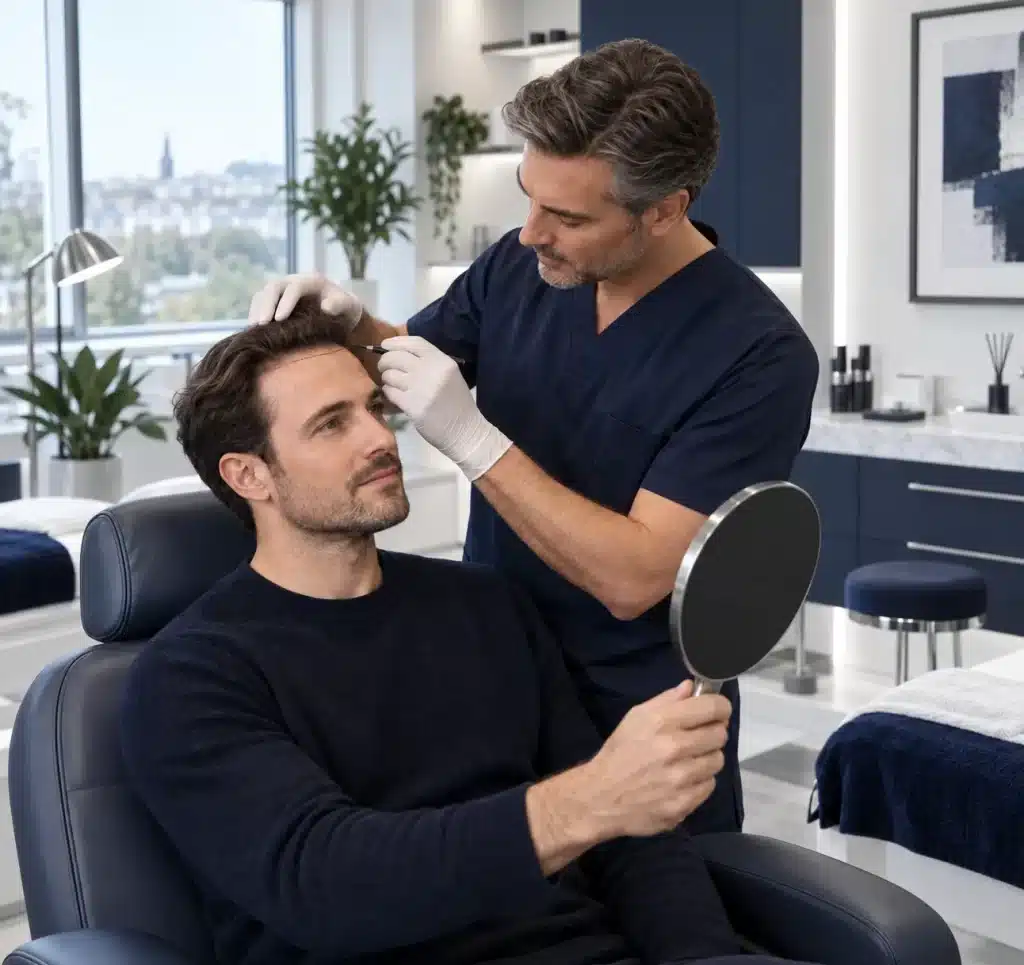
DHI and FUE: What’s the difference?
DHI and FUE are often presented as competing procedures, but they actually describe different stages of a hair transplant.
FUE
Follicular Unit Extraction describes how individual follicular units are removed from the donor area.
DHI
Direct Hair Implantation generally refers to the method used to place those follicles into the recipient area using an implantation device.
A DHI procedure can therefore use FUE extraction followed by direct implantation. The most appropriate approach depends on the individual patient.
Careful planning at every stage
Successful hair transplantation involves considerably more than moving follicles from one area of the scalp to another. Hairline design, donor management and graft placement all influence the final appearance.
- Natural hair growth direction and angle
- Hairline design appropriate to age and facial structure
- Existing and potential future hair loss
- Donor-area availability and density
- Distribution of transplanted follicles
- Preservation of existing native hair
- Long-term treatment planning
Control over angle, direction and placement
The implantation stage is particularly important around the frontal hairline, where small differences in angle and direction can have a major effect on how natural the result appears.
Different follicular units can also be positioned strategically. Finer single-hair grafts may be used at the front of the hairline, while multi-hair grafts can be placed further behind to create the appearance of greater density.
Designed for precise, individualised hair restoration
Precise Placement
Individual grafts can be positioned carefully according to the planned hair pattern.
Natural Direction
Implantation can take account of the natural angle and direction of existing hair.
Personalised Planning
Treatment is designed around your hair loss, donor supply and long-term goals.
What happens during a DHI hair transplant?
1. Consultation
Your hair loss, donor area, medical history and treatment goals are assessed.
2. Planning
The hairline, treatment area and approximate graft distribution are carefully planned.
3. Extraction & Implantation
Follicular units are extracted and implanted according to the agreed design.
4. Aftercare
You receive detailed instructions for caring for the donor and recipient areas.
Who may be suitable for DHI?
DHI may be considered for men and women with suitable forms of hair loss and an adequate donor area. It can be used when treating areas such as the frontal hairline, temples, mid-scalp and crown.
Suitability depends on factors including age, medical history, donor density, the pattern of hair loss and likely future progression.
Common treatment areas
- Frontal hairline
- Temple recession
- Mid-scalp thinning
- Crown thinning
- Selected female hair loss cases
Natural Hairline Design
Hairline design is tailored to age, facial proportions, existing hair and available donor supply rather than using a one-size-fits-all template.
DHI for Hairline & Temples
The technique can be particularly useful where precise direction and individual graft placement are important.
DHI for the Crown
Crown restoration requires careful consideration of the natural circular or spiral growth pattern of the hair.
When Will I See Results?
Hair transplantation is gradual. Some transplanted hairs normally shed in the first few weeks, with new growth developing progressively over the following months.
DHI Recovery
Patients receive detailed postoperative instructions explaining scalp care, washing, saline use and the gradual return to normal activities.
DHI Hair Transplant Cost
Cost depends on the treatment area, number of grafts, complexity and individual treatment plan. A personalised quotation is provided following consultation.
DHI Hair Transplant FAQs
Is DHI better than FUE?
They are not necessarily competing procedures. FUE describes follicular extraction, while DHI generally refers to an implantation technique. An FUE procedure may therefore incorporate DHI-style implantation.
Does DHI require shaving the head?
The amount of shaving required varies according to the procedure and number of follicles being transplanted. Reduced-shave or non-shave approaches may be possible in selected cases.
Is DHI permanent?
Transplanted follicles are generally selected from donor areas more resistant to androgenetic hair loss. Existing non-transplanted hair can still thin over time, which is why long-term planning is important.
Is a DHI hair transplant painful?
Local anaesthesia is used during hair transplantation to minimise discomfort. Some tenderness or discomfort can occur during the early recovery period.
How many grafts will I need?
There is no standard number. The requirement depends on your pattern of hair loss, treatment area, existing density, desired coverage and donor supply.
Can DHI be used for women?
Potentially, yes. However, female hair loss can have several causes and not every type is suitable for transplantation. Individual assessment is important before surgery is recommended.
Find out whether DHI is right for you
Our team can assess your hair loss, donor area and goals before explaining which treatment options may be suitable for you.
Dublin • Cork • Tipperary
Results and suitability vary between individuals. Hair transplantation is not appropriate for every type of hair loss, and treatment recommendations are made following individual assessment.