

A widening parting, more scalp visible under bright light, or a hairline that no longer frames your face as it once did can be difficult to ignore. This androgenetic alopecia treatment guide explains how pattern hair loss is assessed and managed, so you can make decisions based on medical advice rather than promises on a bottle.
Androgenetic alopecia is common, but its impact is personal. For some people, it develops gradually over years. For others, a change in density or hairline becomes noticeable in a matter of months. Effective care begins with understanding the cause, the pattern of loss and the realistic options available for preserving and restoring your hair.
What is androgenetic alopecia?
Androgenetic alopecia is the medical term for hereditary pattern hair loss. In men, it often appears as recession at the temples, thinning through the crown, or both. In women, it more commonly presents as a broader central parting and diffuse thinning across the top of the scalp, while the frontal hairline may remain intact.
The condition is influenced by genetics and the sensitivity of certain follicles to hormones called androgens. Over time, susceptible follicles become smaller. Each new hair grows finer and spends less time in its active growth phase, until some follicles produce very little visible hair.
Pattern hair loss is not caused by poor hygiene, frequent washing or wearing a hat. However, it can exist alongside other concerns, including iron deficiency, thyroid conditions, hormonal changes, inflammatory scalp conditions and stress-related shedding. That is why a proper assessment matters. Treating every form of hair loss as genetic pattern loss can delay the right care.
Androgenetic alopecia treatment guide: start with diagnosis
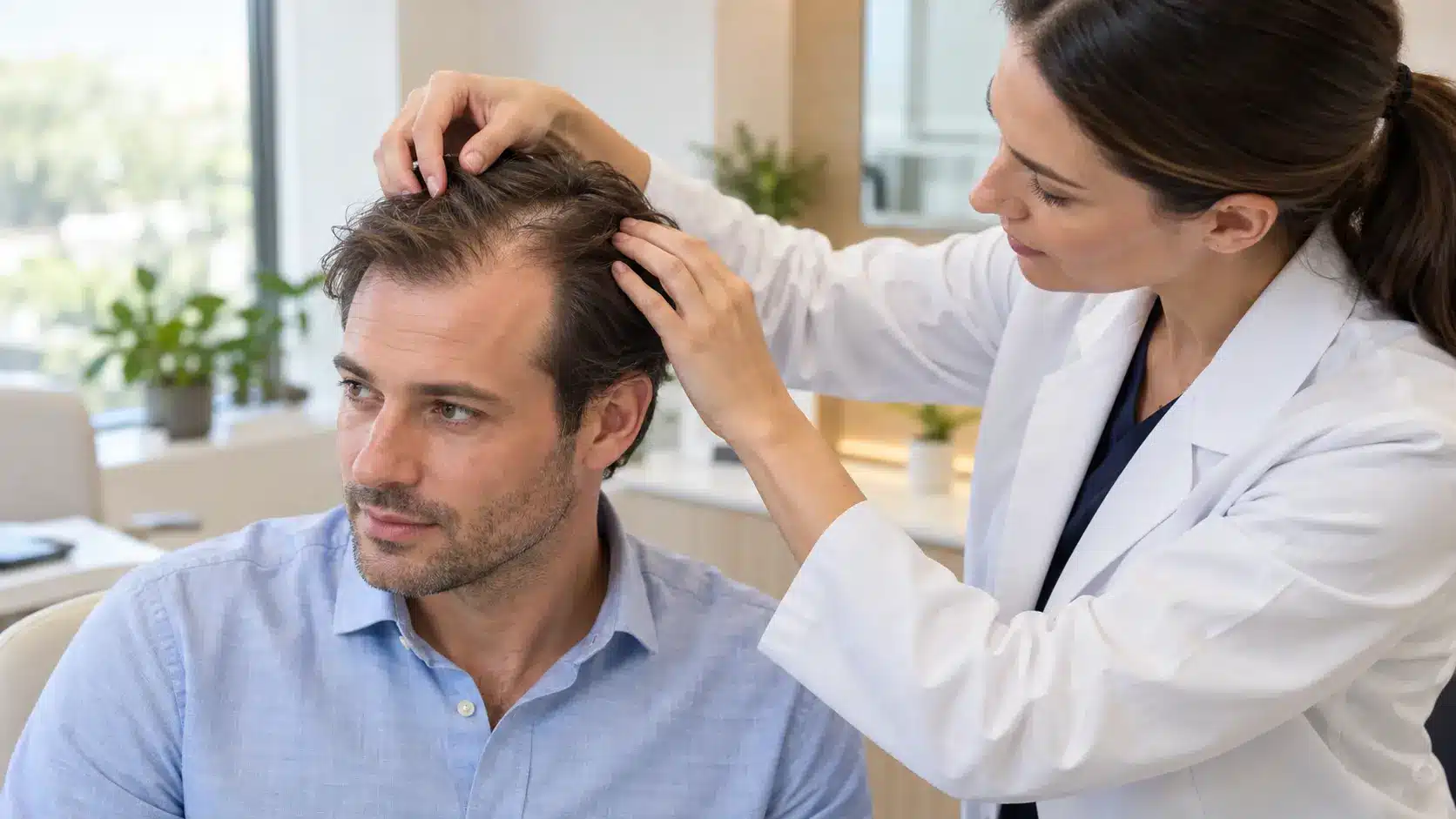
A credible treatment plan should not start with a sales pitch. It should start with a consultation and clinical assessment. Your clinician will consider when the shedding or thinning began, how it has progressed, your family history, medical history, medication use and any recent changes in health, diet or stress levels.
The scalp and donor area should be examined carefully. In some cases, blood tests or further medical investigation may be appropriate, particularly where hair loss is sudden, diffuse, accompanied by scalp symptoms, or inconsistent with a typical pattern.
Diagnosis also means establishing your treatment priorities. You may want to stabilise early thinning, rebuild a receding hairline, improve crown coverage or restore density following years of loss. These goals require different approaches. A person in their twenties with rapidly progressing loss needs a more cautious long-term plan than someone whose pattern has been stable for many years.
Photographs taken under consistent lighting are useful at this stage. Hair loss can feel as though it is moving quickly, while gradual changes are often difficult to judge day to day. Clinical photography creates a reliable baseline and helps measure response over time.
Medical treatment can help protect existing hair
For many patients, the first objective is to retain and strengthen the hair that remains. Medical treatment may slow progression and, in suitable candidates, improve hair calibre and density. It is not an overnight fix, and results depend on the individual, the stage of hair loss and consistent use.
Topical minoxidil is a commonly used option for men and women. It is applied to the scalp to support the growth cycle of susceptible follicles. Some people experience temporary increased shedding when beginning treatment, and irritation can occur. This should be discussed with a clinician rather than assumed to mean the treatment has failed.
Certain prescription treatments may also be considered for appropriate patients following medical assessment. These are not suitable for everyone, particularly where there are relevant medical conditions, pregnancy considerations or concerns about potential side effects. A specialist should explain the expected benefit, limitations and safety considerations clearly before any prescription is started.
Medical treatment works best when expectations are realistic. It can preserve vulnerable native hair and improve its appearance, but it cannot reliably recreate a hairline where follicles have been absent for many years. It also needs commitment. If treatment is stopped, any hair maintained through that treatment may gradually be lost again.
Where laser light therapy may fit
Low-level laser light programmes can be considered as part of a non-surgical plan for suitable patients. These programmes are designed to support follicle activity and may be particularly useful for people with early thinning who want a structured, non-invasive approach alongside medical advice.
Laser light therapy is not a replacement for diagnosis or a guaranteed solution for advanced baldness. Its value depends on the pattern and severity of loss, the wider treatment plan and adherence to the programme. It is most effective when presented honestly as one possible component of longer-term management.
When an FUE hair transplant is the right option
Hair transplantation redistributes permanent hairs from the donor area, usually at the back and sides of the scalp, to areas affected by thinning or baldness. In follicular unit extraction, or FUE, individual follicular units are carefully harvested and implanted to create a natural-looking hairline, improve density or restore crown coverage.
A transplant can be transformative, but it is not simply a matter of filling every visible area. Donor hair is finite. The design must account for your facial proportions, age, family pattern of loss, future progression and the quality of the donor area. A conservative, well-designed hairline often looks more convincing over time than an aggressive design that uses too much donor hair too early.
Not everyone is immediately suitable for surgery. If hair loss is unstable, a clinician may recommend medical treatment first to help preserve native hair. Without that protection, transplanted hairs can remain while surrounding native hair continues to thin, potentially creating an uneven appearance later.
For patients who value discretion, non-shave FUE may be an option depending on the procedure and the number of grafts required. It can allow existing hair to remain longer around the treatment area, although it is not appropriate for every case. The technique should be selected for clinical reasons and desired outcome, not simply because it sounds less visible.
What natural-looking restoration really requires
Natural results are built through planning and precision. The direction, angle and placement of each graft influence how hair grows and how the hairline reads at close range. Single-hair grafts are generally used at the leading edge of a hairline, with carefully selected follicular units behind them to create soft, progressive density.
Density also needs to be judged realistically. A transplant cannot reproduce the density of untouched adolescent hair, especially across a large area. The aim is visual coverage that suits the individual, makes intelligent use of available donor hair and remains appropriate if further thinning occurs.
Recovery deserves equal attention. Small scabs and temporary redness are expected after FUE, while transplanted hairs commonly shed before new growth begins. Early growth can be fine and uneven. Meaningful development takes months, and final maturation can take up to a year or longer. Good post-procedure care protects the grafts and gives you clear guidance at each stage.
Choosing a treatment plan that lasts
The strongest plan often combines treatment routes rather than presenting surgery and non-surgical care as competing choices. Medical management may protect native hair, laser light therapy may support an early-stage programme, and transplantation may restore areas where follicle loss is already established.
Your plan should also include review points. Hair loss is a long-term condition, and your needs may change. A review allows your clinician to assess progress, adjust treatment if appropriate and plan responsibly for the future rather than responding only when further loss becomes obvious.
Be cautious with clinics that promise a fixed number of grafts before examining you, guarantee a particular density, or push surgery without discussing future hair loss. The right recommendation may be a transplant, medical therapy, monitoring, or a combination. Honest clinical advice should make that distinction clear.
At Ailesbury Hair Clinic, treatment planning is centred on medical assessment, precision FUE techniques and ongoing aftercare, helping patients make informed choices with their long-term appearance in mind.
If you are concerned about thinning, do not wait for uncertainty to become frustration. A specialist consultation can establish what type of hair loss you have, whether it is progressing, and which treatment route offers the most sensible next step for you.