

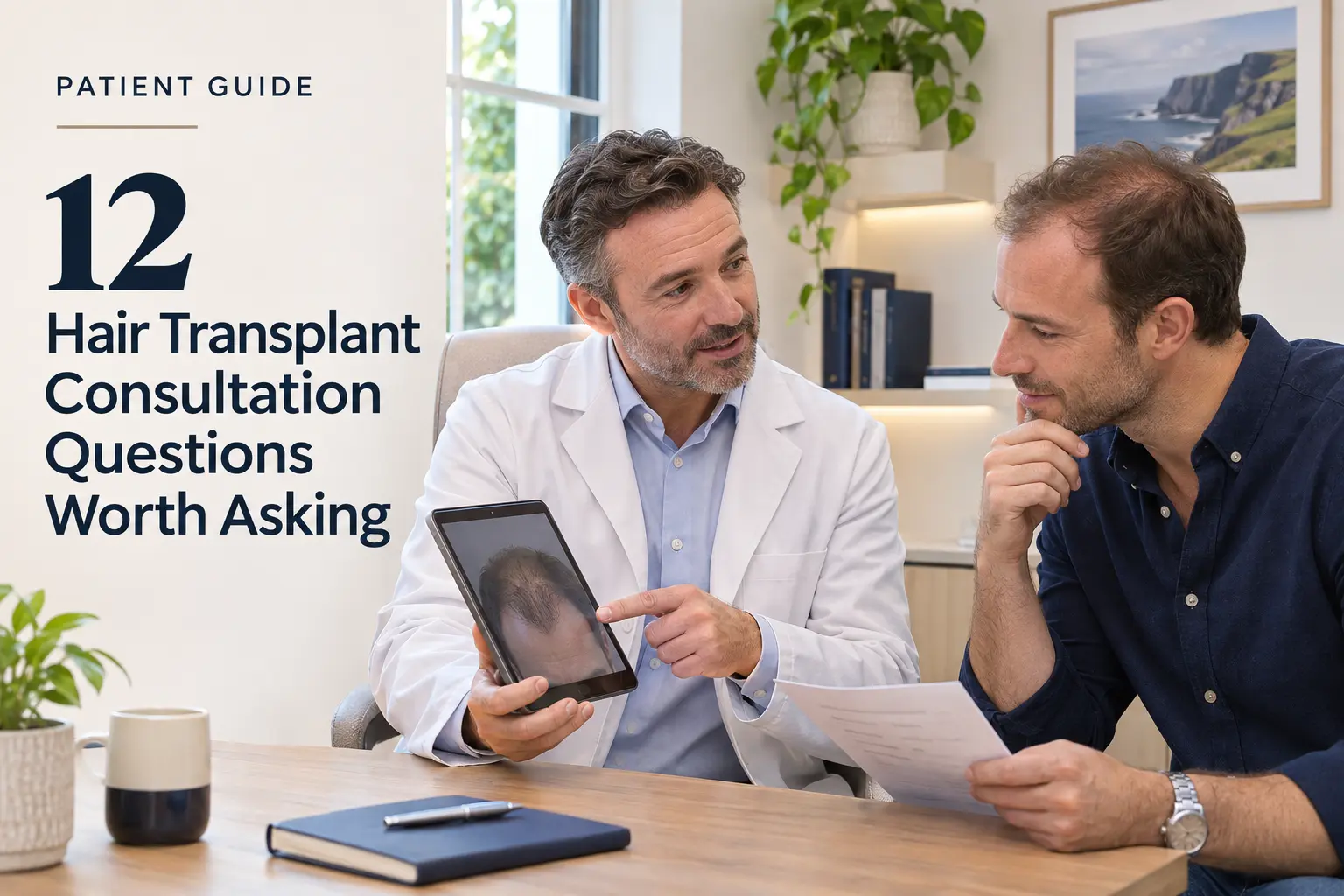
A hair transplant consultation should leave you with far more than a price and a proposed date. You should understand why your hair loss is happening, whether surgery is appropriate at this stage, and what a realistic result could look like for you. Bringing considered transplant consultation questions helps turn an emotional decision into an informed clinical one.
For many people, hair loss has been gradual enough to normalise in private, then suddenly difficult to ignore in photographs, meetings or social settings. A good consultation creates space to discuss that change without judgement. It also tests whether a transplant is the right route at all. The strongest treatment plan is not necessarily the quickest route to surgery.
Why the consultation matters before any transplant
FUE hair transplantation redistributes healthy follicles from a donor area, usually at the back and sides of the scalp, to areas affected by thinning or recession. It does not create an unlimited new supply of hair. That makes planning essential, particularly when hair loss is still progressing or the donor area is limited.
A medically led assessment should consider your pattern of loss, family history, scalp and hair characteristics, general health, medication, age, and expectations. For some patients, a non-surgical programme or a period of monitoring is the sensible first step. For others, surgery may be suitable, but only with a conservative design that protects options for the future.
The questions below are not a script to rush through. They are prompts for a useful conversation with a clinic that should be comfortable explaining its recommendation clearly.
Transplant consultation questions about your suitability
1. What is causing my hair loss?
Pattern hair loss is common, but it is not the only explanation for thinning. Hormonal changes, nutritional factors, illness, inflammatory scalp conditions, traction and certain medicines can all affect hair growth. Ask how your clinician has reached their view and whether any further assessment is needed before treatment planning begins.
A transplant can improve areas where follicles have been permanently lost, but it will not address every underlying cause of shedding. Establishing the diagnosis first protects you from treating the visible symptom while missing the wider issue.
2. Is a transplant right for me now, or should I wait?
This is one of the most valuable questions to ask. A receding hairline at 25 and diffuse thinning at 55 may require very different planning, even where both patients are suitable candidates. If your loss is active, your clinician may recommend stabilising it first or designing a transplant that accounts for likely future change.
There is no benefit in pursuing an aggressive hairline that cannot be supported by your donor supply later. A natural-looking result should suit your facial proportions, current density and probable pattern of loss, not simply recreate the hairline you had as a teenager.
3. Is my donor area strong enough?
Your donor area is a finite resource. Ask how it will be examined, what characteristics make it suitable or unsuitable, and whether the proposed extraction level is designed to avoid visible thinning at the back or sides of the scalp.
Hair calibre, density, curl, contrast between hair and skin, and the size of the area to be restored all influence what can be achieved. A responsible consultation should explain the trade-off between coverage and density rather than making a blanket promise about graft numbers.
Questions about technique and who performs the procedure
4. Which technique do you recommend, and why?
FUE involves removing individual follicular units from the donor area and placing them into carefully created recipient sites. It can be a suitable option for patients who prefer shorter hairstyles or who want to avoid a linear donor scar. However, it still requires precision and careful extraction planning.
If you are concerned about visible shaving for work, family or personal reasons, ask whether non-shave FUE is appropriate. This approach can offer greater discretion for selected patients, but suitability depends on the treatment area, hair characteristics and the scale of the procedure. The right technique is the one that serves your clinical needs, not the one with the most appealing label.
5. Who will assess me, design my hairline and carry out each stage?
A transplant is not a commodity service. Ask exactly who will be responsible for your diagnosis, surgical plan, donor extraction, recipient-site creation and graft placement. You should also ask about the medical credentials, hair restoration experience and oversight available on the day.
The design stage deserves particular attention. A well-planned hairline is irregular in the right way, age-appropriate and placed with restraint. It should work when seen close up, under bright light and as your appearance changes over time.
Questions about results, recovery and long-term planning
6. What result is realistic for my hair type and level of loss?
Request a direct answer, including the limitations. A transplant may improve framing around the face, reduce the appearance of a receding hairline or add coverage to a thinning area. It may not provide the density of an untouched full head of hair, especially over a large crown area.
Ask to discuss results in patients with a broadly similar hair type, degree of loss and treatment goal. The relevant point is not whether another person looks transformed, but whether the proposed plan is credible for your starting point.
7. How many grafts are proposed, and how was that number decided?
Graft numbers should follow the plan, not lead it. More grafts do not automatically mean a better outcome. Excessive extraction can compromise the donor area, while placing too many grafts at the front may leave insufficient supply if crown loss progresses.
Your clinician should explain the intended coverage, density priorities and whether the plan is designed as one procedure or part of a longer-term strategy. If a number is offered without a clear rationale, ask more questions.
8. What will recovery look like in the first weeks?
Ask about swelling, redness, scabbing, washing, sleeping position, exercise, headwear and when you can return to work or travel. Recovery varies by procedure size, skin sensitivity and the nature of your job. A non-shave procedure may make the early period less conspicuous for some people, but it does not remove the need for careful aftercare.
You should also understand the normal shedding phase. Transplanted hairs commonly shed before new growth begins, which can feel discouraging if you are not prepared for it. Visible growth develops gradually, and final maturation takes time. A clinic should give you a realistic timeline rather than encouraging expectations of an immediate cosmetic change.
9. What aftercare and support will I receive?
Post-procedure care is part of the treatment, not an optional extra. Ask who you can contact if you are worried, what follow-up appointments are included, how progress will be reviewed and what signs would require prompt clinical advice.
Clear aftercare instructions reduce avoidable anxiety in the days after surgery. Ongoing support also helps ensure you know how to care for both the transplanted area and the existing hair around it.
Questions cost and future hair loss
10. What is included in the quoted cost?
A clear quotation should explain what it covers: consultation, procedure, anaesthetic, graft handling, medication where appropriate, aftercare and follow-up. Ask whether any part of the plan could change the cost and whether additional procedures may be advisable later. Price matters, but it should be weighed alongside medical oversight, technique, planning and support.
11. How will we manage my existing, non-transplanted hair?
A transplant does not stop genetic hair loss in surrounding areas. Ask whether non-surgical options, such as clinically appropriate medical treatment or laser light programmes, could help preserve existing hair. The answer depends on your diagnosis, medical history and preferences, but the question ensures the plan looks beyond surgery day.
12. What happens if my hair loss progresses?
Future-proofing is central to good transplant planning. Discuss how the proposed design would still look if further recession or crown thinning develops. This may mean choosing a slightly more mature hairline, prioritising a particular zone or retaining donor capacity for the future.